6 Types of CVs to help you boost your job hunt
Home | About | CV Design Samples | CV Writing Samples
When it comes to writing a CV, there are tonnes of advice out there on the best ways to format your document. But the approach you take very much depends on your background and your future career expectations. Having a look at CV examples is a great first step, as it gives you an idea of the type of layout you can go for.
A CV should always cover the basics. It needs to show off your skills and why you are suitable to the position you’re applying for. It also needs to give a clear overview of who you are, what you’ve achieved so far and what you hope to secure in your next position.
While it might seem daunting, perfecting your CV needn’t be a major roadblock. Below, we’ll take you through several CV samples, to help you understand what the best CV examples look like.
Traditional CV
A traditional CV is sometimes known as a chronological CV. This is the most common type of CV out there and enables you to match your work experience, qualifications and skills directly to the job in question. It should provide a complete overview of yourself and tell the reader why you are the perfect candidate for the role.
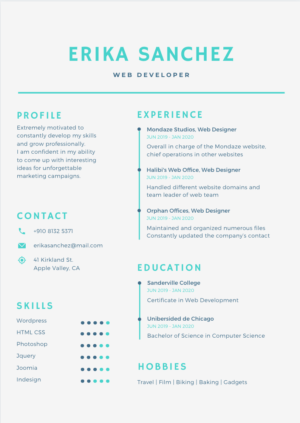
Like many other types of CV, you should write your experience and education in reverse chronological order, focusing on your most recent experience first. It tends to start with your personal profile, where you provide a summary of who you are, your background and what you are looking for in your next role. Following this will sit your work experience and your education.
Entry-level CV
If you’re just starting out on the career ladder, you should refer to entry-level CV examples. This style gives you an opportunity to focus on the skills that you’ve gained throughout your education, rather than focusing on your experience. Think about the transferable skills that you’ve learnt so far. You will have expressed teamwork, time management and organisation during your studies.
If you don’t have any work experience, don’t feel the need to include this section for the sake of it. Employers will appreciate that you’ve only just finished your education. This is also true if you are a graduate that doesn’t have any experience. You can bulk out your hobbies and interests section instead – this usually gets removed as you gain more momentum throughout your career. So maximise it to its full potential now and think about what makes you unique. This will ensure that you stand out against other candidates.
Creative CV
If you work in the design/arts/media industries, a creati may be suited to you. This will include all of the relevant information from a traditional CV, but you can tailor it with a personal design to show off your creative flair. If you are looking for a job in one of these areas, producing a creative CV can help you to stand out from the crowd and make a great first impression.
It seems that the humble 2 page word document just doesn’t cut it for those creative jobs anymore, standing out from the crowd is a must for those that want to bag the best opportunities.
With the average recruiter spending just 6 seconds reviewing a CV, never has “make first impressions count!” been more apt, check out these awesome creative CVs.
Management CV
If you want to take the next step in your career and gain more responsibility, you might want to have a look at management CV examples. With this template, you must show that you have the key skills and experience needed to become a manager. Therefore, you should use key action verbs to demonstrate that you are a strong leader. Consider words such as guided, developed, achieved, led, organised, supervised, etc.
Alongside this, as your career history starts to grow, you may need to be selective about the positions you include on your CV. Your CV shouldn’t span over two pages. So, cut out, or cut down, any jobs which are not relevant to the position that you’re applying for. If you’re applying to a senior management position, at an executive level, you’ll also need to showcase your personal brand.
How to write a CV:
This guide will show you how to write a great CV that’s ready for 2020 and beyond.
What is a CV?
Your CV, short for curriculum vitae, is a personal marketing document used to sell yourself to prospective employers. It should tell them about you, your professional history and your skills, abilities and achievements. Ultimately, it should highlight why you’re the best person for the job.
A CV is required when applying for a job. In addition to your CV, employers may also require a cover letter and a completed application form.
Browse CV samples
What to include in your CV in 2020
While the structure of a CV is flexible, bending to your unique skill set and experiences, there are particular sections that employers expect to see on your CV regardless.
Here are the sections you must include in your CV:
Name, professional title and contact details
The first part of your CV, positioned at the top of the page, should contain your name, professional title and contact details. Under no circumstances should you title your CV with ‘curriculum vitae’ or ‘CV’ as it’s a waste of valuable space. Treat your name as the title instead.
When it comes to your contact details, your email address and phone number(s) are essential. Once upon a time, it was customary to include your full address on your CV. Today, you simply need to list your town and county.
If you like, you can also include a link to your LinkedIn profile in this section – but only if it’s up to date!
Here is an example of how your name, professional title and contact details might look:
Forename Surname | Professional Title
Location: Town, County
Phone: 01234 567890
Email: name@example.com
Personal profile
A personal profile, also known as a personal statement, career objective and professional profile, is one of the most important aspects of your CV. It’s a short paragraph that sits just underneath your name and contact details giving prospective employers an overview of who you are and what you’re all about.
You should tailor your profit to every job you apply for, highlighting specific qualities that match you to the role. Aim to keep your personal statement short and sweet, and no longer than a few sentences. To make the most of this section, you should try to address the following:
- Who are you?
- What can you offer the company?
- What are your career goals?
Experience and employment history
Your employment history section gives you a chance to outline your previous jobs, internships and work experience.
List your experience in reverse chronological order as your recent role is the most relevant to the employer.
When listing each position of employment, state your job title, the employer, the dates you worked and a line that summarises the role. Then bullet point your key responsibilities, skills and achievements, and bolster each point with powerful verbs.
It helps to choose the duties most relevant to the job you’re applying for, especially if it’s a long list. If you have many years’ worth of experience, you can reduce the detail of old or irrelevant roles. If you have positions from more than 10 years’ ago, you can delet them.
Here’s an example of how to lay out each position of employment on your CV:
mmm yyyy – mmm yyyy
Company Name, Location
Role Title
Outline
xxxxxxxxxxxxxxxxxxxxxxxxxxxxxxxxxxxxxxxxxxxxxxxxxxxxxx
Key responsibilities
- xxxxxxxxxxxxxxxxxxxxxxxxxxxxxx
Key achievements/projects
- xxxxxxxxxxxxxxxxxxxxxxxxxxxxxx
Education and qualifications
Like your experience section, your education should be listed in reverse chronological order. Include the name of the institutions and the dates you were there, followed by the qualifications and grades you achieved.
If you have recently left education, you may write your degree, A-levels or GCSEs (or equivalents) like so:
Institution name – Dates attended (from – to)
Qualification/subject – Grade
If you have a degree, you could list a few of the most relevant modules, assignments or projects underneath.
For professionals that are a little further along in their careers, or have many certificates in their repertoire, you can lay your qualifications out in this way:
Qualification, grade – Institution – Year
Additional sections
There is a range of additional section that may strengthen your CV and highlight your skills. Here are just a few you can include if you have room:
Key skills: If you’re writing a functional CV, or have some abilities you want to show off to the employer immediately, insert a key skills section underneath your personal profile. You should aim to detail four to five abilities at most.
Hobbies and interests: If you feel that your CV is lacking, you can boost your document by inserting a hobbies and interests section at the end. This can help to show how well you fit into the company or the industry. For example, if you’re applying for an enviromental job, why not include that you have a big interest in climate change activism?
Cover Letter Writing Tips
Home | About | CV Design Samples | CV Writing Samples
A well-written cover letter is like a handshake. To make a good impression it should be personable and professional. It’s your introduction to a hiring manager—a man or woman you haven’t yet met in person—but one you’d like to meet in a job interview. Therefore, it’s not a document to take lightly. It can make or break your chance to land the job of your dreams. You’ll want to include all the information necessary to catch the individual’s attention, to inspire him or her to read it through to the last line, and to comb through your attached CV to see if you qualify for the job he or she hopes to fill.
1. Write to the ‘right’ person.
Send your cover letter to the correct person. In other words, avoid addressing an individual as Dear Sir or Madam, or To Whom it May Concern, or Dear Hiring Manager. Take a moment to call the company and find out the name of the current hiring manager. And if you have a name already, verify that that person is still employed with the company. Ask for the correct spelling, as well. For example, the name Smith can also be spelled Smythe. The name Robin or René is used by both genders, so be sure to check out that detail too.
The more specific you are, the better chance you have of reaching the person who can help you the most, the one in charge of hiring someone for the position you’re seeking. Get off on the right foot by writing to the right person!
2. Start with a great introduction
A first impression matters – both in person and in print. So open your cover letter by grabbing the hiring manager’s attention immediately. This is not the place to say, “I have worked in sales for five years and therefore, feel that I could do a good job of filling the opening at your company for a sales director.” This type of writing lacks energy and may only motivate your reader to toss the letter into the trash can and move on to the next one.
Instead, get to the business at hand. Let the hiring manager know why and how you are the one to fill the position listed online or on a job board. Try something like this: “With five years as the leading sales person at ABC Company in Any City, I am now ready to step into management and believe I’m a good fit for the position of sales manager that you listed on GetAJob.com.”
A hiring manager will then see you as the confident and self-assured person you are and will more likely want to meet with you in person.
3. Simplify!
Franklin Delano Roosevelt, former president of the United States, once said the
following regarding speakers: Be sincere; be brief; be seated. Perhaps the same, with a small modification, could be said of cover letter writers: Be sincere; be brief; be finished. In other words, get right to the point and then close.
Limit your cover letter to one page or less. Stick to the facts that apply to the job in question. Indicate your qualifications, experience, and interest in the opening. Avoid gobbledygook in your writing—such as buzzwords and professional jargon that some people may not be familiar with.
And of course stay away from any personal references or attempts to be funny or ‘cute.’ Keep in mind that your cover letter is like a handshake. It’s the hiring manager’s first contact with you. Make it a friendly, professional, and positive one.
4. Present your best.
Help your reader move through your cover letter with ease. Avoid colored stationery. Select good-quality white paper and use the same font and type size for your letter as for your resume. Keep in mind that a solid block of text can be overwhelming. Break up your cover letter with short paragraphs and lots of white space.
Consider your reader – the hiring manager who is inundated with dozens of cover letters a week. He or she is more likely to pay attention to your letter if you submit a visually appealing document that allows for easy reading and a quick assessment of your qualifications for the job. You want to help him or her get to a final decision as soon as possible. And you want that decision to be in your favor.
5. Consider the company.
What can you do to help the company increase revenue, work more effectively with employees, and deliver efficient customer service? You must grab the employer’s attention within one to three seconds or you risk your cover letter going into the shredder. So don’t squander even one word on unnecessary communication. Make it clear that you raised profits at your former place of employment by such and such number of dollars, or that you expanded your customer base by training new employees to open additional territories, using a proven technique, or delivered a program or new idea to management that resulted in thus and so.
In other words, present tangible evidence of what you did to improve your value to the former company. Then focus on what you can do for the new organization that would build momentum and increase revenue, as well as relieve management of stress over maintaining the bottom line.
6. Edit and proofread.
Never send a cover letter that you haven’t thoroughly edited and proofread for punctuation, spelling, and usage errors. As the best-selling author Jerry B. Jenkins has said, “Everyone needs an editor.” He’s right. Everyone does. None of us is above making grammatical mistakes.
When it comes to cover letters, you’ll want yours to be clean, clear, and easy to read. Therefore, if necessary, hire a professional to go over your writing, to correct errors, and to point out where and how you can communicate more effectively so the hiring manager will read your cover letter with enthusiasm and want to call you for an interview.
7. Be honest and straightforward.
People can see through pretense to the real you so you might as well be real right from the start. Show the hiring manager who you are in terms of your talent and ability to do the job he or she wants to fill. Let him or her know how your accomplishments and titles from previous employment can benefit the new company. In other words, what can you do that will help the organization increase its bottom line? Imagine the interviewer asking you this question. “What can you bring to this job that will help my company grow and prosper?” Then answer it in your own words based on your experience. Make that clear in your cover letter. That’s the kind of information that will help your cover letter stand out from the rest and inspire the hiring manager to call you for an interview.
8. Avoid exaggeration.
Some job seekers are so desperate to land a position they will exaggerate (even lie) in order to get an interview. Honesty is and always has been the best policy when it comes to any area of life, and that’s true of writing cover letters, as well. If you were an assistant manager at a retail store, don’t say you managed the store. If you received a customer service award, mention that but don’t blow it up to be something bigger than it is—such as ‘All Star’ or ‘Pacesetter.’
Hiring managers don’t necessarily believe everything they see on paper. They check references. They ask questions. They look into a person’s background. Think about your answers if queries come your way that you cannot answer adequately. There are plenty of jobs out there, including the ideal one for you at this season of your career. You don’t have to be dishonest to get it.
Commit yourself to displaying your talent and skills truthfully and with enthusiasm. Show the interviewer who you are and then you won’t have anything to hide from or be afraid of.
9. Ask for what you want – an interview.
A cover letter is the place for you to share your skills and accomplishments and your ability to take on the new job. It is also an opportunity to ask for what you want—an interview for the job you’re seeking. Be sure to include that question before you close the letter and sign your name. Make it easy on the hiring manager by stating that you are available to speak in person at a time and date that is convenient for him or her.
Keep in mind that company representatives are busy people. They receive hundreds of cover letters a month—maybe more. Your letter must stand on its own, drawing attention to you and your ability in a way that motivates an interviewer to call you for a meeting.
Therefore, a question is totally appropriate. May I come in for an interview? or I look forward to meeting you in person. Do you have time next week for me to stop by your office? Name the hour and date and I’ll be there. Such direct communication presented in a polite and professional way will motivate the hiring manager to respond favorably.
10. Follow up with a thank you note.
Everyone appreciates the words ‘thank you.’ Most people don’t hear them often enough. Of all the correspondence you share with business associates, colleagues and hiring managers, your notes of appreciation for what they’ve done for you are among the most important.
Therefore, be sure to follow up your cover letter and résumé with a letter, e-mail or phone call that expresses your gratitude for the time the hiring manager spent reading your submission. Never just sit back and wait for a response. Take the initiative. Be pro-active. Not only will you be remembered for your thoughtful gesture but also you’ll stand out from the crowd of people who are more concerned with what they can get than with what they can give.
Below is a perfect example of our attention grabbing Cover Letter.
Cover Letter Sample
Mr President Lumumba
XYZ CVee company (1-2 top margin)
145 Wattle Grove (Return Address)
( Consider using your CV heading and contact info. here)
June 2020 Date
Dear Mr. Lumumba Greeting (Double Space)
Introduction Paragraph: This is the Attention Grabber. This paragraph should arouse the readers interest. If you’re applying for a specific internship or job, mention the position title and the name and date of the vacancy listing. Give the name of the person that referred you to the company, if appropriate. Most introductory paragraphs are short, so be brief and clear.
Middle Paragraph: This is your Sale Pitch. It’s the longest of the paragraphs. Persuade the employer that you’re worth the interview. Mention specific skills, education, and / or experience (internship, class projects, work, etc.) that make you an attractive candidate for the position. Highlight special skills. Reveal a personal goal that could be realized in this company. Prove that your skills and abilities can satisfy the employers needs.
Final Paragraph: This is your Request for action. Ask for an interview or a meeting to discuss how your skills might assist the employer. Offer to provide more information (e.g. samples of your work, more details of your past experience, etc.) You may ask the employer to contact you, or you can take a lead, and indicate that you’ll be contacting them to schedule a specific time to meet. Provide your phone number and email address, and the best time to contact you.
Thank you for your consideration.
Sincerely, (Closing Line)
DON’T FORGET TO SIGN YOUR LETTER!
Job Seeker
Enclosure
(Note: Single space within each paragraph. Double space between paragraphs.)
Job Interview Tips
Home | About | CV Design Samples | CV Writing Samples
A successful job interview is the essential key in your chain of job-search events.
This important meeting between you and a hiring manager is not a place to talk about football scores, movie hits, or the latest joke, though a bit of light conversation can be appropriate as you get to know one another. It is much more than this. It is your golden opportunity to make a first-class impression on the man or woman who has the power to offer or withhold an offer for the job you want.
Therefore, it’s important to prepare for it carefully and to stay focused while in the room answering questions, posing some of your own, and discussing what you can bring to the company that will help it grow and prosper.
From the moment you put your foot in the door till you close the door behind you when you leave, make every second count. Be your best. Do your best. Give your best. Follow the great tips we’ve included here to stand out from the crowd.
Prepare and practice.
Of course you won’t walk into an interview with mustard on your tie or a broken heel on your shoe. But important as your appearance is to an interviewer, the way you speak and respond to questions is even more important.
Be prepared. How? By considering the questions that might be asked and having your answers in hand. That doesn’t mean you should memorize your responses word for word. But it does mean you should know enough about the company, its mission, and your potential place within it to be able to have a lively and high-quality conversation with the hiring manager.
It’s also wise to do a bit of role-playing with a business colleague, friend, or relative ahead of time. Dress the part. Walk into the room as you would on the ‘real’ day and conduct yourself in as professional a manner as you can so you’ll feel ready when the time comes for the interview that counts.
Avoid treating this opportunity lightly. Approach it in a way that suits your personality and comfort zone. Be warm and friendly, look the person in the eye, offer a firm handshake, and sit forward in your seat so you can stay alert.
Get clear about what you know and want.
Think ahead of time about what you want and review what you know. In other words, have your employment objective, related experience, education, and previous professional duties thoroughly memorized so you can engage in dialogue with the hiring manager without hemming and hawing.
When a person hesitates, rolls his or her eyes, or fidgets with coins in a pocket or a hemline on a garment, the interviewer will turn off. He or she doesn’t have time to waste on people who are unclear about what an interview is for and who can’t respond in a professional and courteous manner.
Therefore, it’s essential that you plan for such a meeting as you would a long-awaited vacation. Lay out on paper and in your mind the details you’ll need. Have a note card with you in case you have to refer to a couple of key words to remind you of what you intended to say. Better that than stumbling through an answer because you’re nervous or scared. Your appearance and your presentation can make the difference between a yes and a no.
Match your responses to your claims.
If you acquired an MA degree or completed your training as a car mechanic or medical lab technician, you can work that into your conversation—even though you may have included it in your resume.
A hiring manager may have read your resume some time prior to meeting you and may not recall every detail. Therefore, it’s fine to refer to such training in a subtle way. For example, “I remember while training as a dental hygienist that it’s important to . . . ” or “One of the best experiences I had relating to training sales people at my last job was applying the principles I learned while studying for my master’s in sales and marketing.”
These are simple reminders to the hiring manager of your background and education without sounding like you’re bragging.
Know your strengths.
If a hiring manager asks you to talk about your unique strengths for a teaching position, for example, be ready to mention something specific, such as “I’ve studied the four basic personality types and that helped me more than anything when faced with individual differences in the students I dealt with at the two inner-city schools where I taught.” This is a much better response than “I have a sixth sense when it comes to students and their differences.” Refer to a trait or aspect of your training that will mean something to the hiring manager.
Also be prepared for questions that might arise from your response, such as: “What personality type are you?” or “What type am I?” You may need to go a step further than a simple one-word answer such as “Sanguine” or “Choleric.” Add a sentence or two that illustrates the traits that describe that personality type. For example, “I’m a combination of Sanguine—friendly, outgoing, encouraging––and a Choleric, one who delegates authority and gets the job done on time.” And then show how those characteristics can be an asset on the job you’re applying for.
Refer to your weaknesses in a positive way.
The hiring manager may ask about your weaknesses. This is not the time or place to say, “I haven’t given that much thought,” or “I’m not sure I have any when it comes to this kind of work. I feel totally qualified for whatever comes my way.”
No one has it all together no matter how well he or she is trained or prepared. It’s more realistic and professional to refer to something that has challenged you but do so in a way that shows what you learned from it and how you’ve changed because of such and such an experience.
For example, suppose you took on a sales position but realized you don’t like ‘selling.’ Your stats were low month after month and you were in danger of losing your position. But then you sought the advice of a more experienced salesperson and he suggested that you ‘Serve, don’t sell.’ He reminded you to put the customer’s needs ahead of your statistics, and watch how that alone could transform your attitude and your sales figures. Following that event, you had a very successful quarter and eventually you were promoted to sales manager. Having this conversation with the hiring manager will convince him or her that you can handle whatever comes your way.
Be honest and direct.
Suppose you’ve lost a job or you were laid off temporarily because of a downturn in the company’s business. Or perhaps you had to take extended sick leave due to an injury.
Such events can happen to anyone at any time. There is nothing to be ashamed of. Speak right up, admitting what occurred, without giving way to emotion, and acknowledging that although it was a tough time, you understand that lay-offs and accidents are part of life. But now you’re ready to resume your profession and you’re eager to make a full commitment to the job and to the company.
With such a positive attitude and an acceptance of life on life’s terms, a hiring manager will be more likely to consider you seriously. Employers are always interested in hiring people who are willing to speak the truth, leave the past behind, and make a fresh start.
State your long- and short-term goals.
It may be difficult to state with absolute clarity where you want to be five or ten years down the road. The economic downturn in recent years has proven that it’s nearly impossible to project one’s work life beyond a few months or a year or two at the most.
However, if you are asked about your long- and short-term goals, be forthright without being too specific. You can hardly say, “I plan to be store manager in five years or president of the company in ten years,” but you can say with integrity, “I plan to walk though every door that opens in this industry, especially those that lead to management—where I feel I can best use my natural and learned abilities in leadership and communication.”
That kind of response does two things. It shows the hiring manager you have a commitment to the future of a particular profession (whether sales, law, medicine, teaching, international trade) and that you are a flexible individual—one who can adapt and adjust to the changing job market.
Live up to your personal standards.
You may consider your personal standards just that—personal. But in today’s job market where so many individuals have been brought down because of corrupt behavior, many employers are looking for people who have high standards of integrity and ethics. They want to know whom they are taking on, and how that person will respond if asked to compromise his or her beliefs or standards for whatever reason.
No job or salary or position of importance or power is worth sidestepping your personal code of ethics. In the end, that’s all any of us really has. So if you are asked to talk about your standards or how you’d respond to a proposition that would compromise the company or yourself, be truthful. “I don’t accept payment for favors.” “I treat all customers as equals.”
“I delegate responsibility according to an employee’s commitment to the company and his or her record of performance.”
You don’t have to answer ‘personal’ questions about your family or religion, and most employers won’t ask such questions, but be prepared to talk about your standards as they apply to your work life.
Ask questions of the interviewer.
Keep in mind that as the hiring manager is interviewing you, you can be interviewing him or her in your mind. Notice the person’s attitude, demeanor, and presence. This individual represents the company, so be on the lookout for clues that will help you decide whether or not this is the organization you want to join.
Then when the time is right, pose some questions of your own. You may want to put them in a written list so you can refer to them easily. For example, what are the vacation and health benefits, and what growth opportunities are available? Will you be working with people in other departments? If so, what will that require of you? How much leeway would you have in making decisions, exercising your creativity, responding to the demands of those around you? How soon might you be promoted to a higher position with additional responsibilities?
The important thing to remember is that the job you accept has to work for you as well as for the company. Never back away from asking your questions. Then in the event you’re offered the position, you’ll be able to accept or decline with complete confidence.
Know what you’re worth and ask for a salary to match.
Decide what you’re worth, based on your skills, training, experience, degree, and according to the going rate for similar work in your industry. Then walk into your interview certain of the compensation you need and want, as well as your ability and willingness to do what the job requires.
Of course the hiring manager will open this subject, but don’t assume he or she has the final say. If you’re told the company has a certain limit on salaries for new employees or for people in the position you’re seeking, speak up. When you know what you’re worth and what the profession is paying for such a job, you can counter that statement and be prepared to negotiate. You won’t be able to do a truly effective job if you feel underpaid and unresolved about this essential issue––your livelihood.
Graduate / Entry Level Jobs Tips
Home | About | CV Design Samples | CV Writing Samples
School / college leavers and university graduates about to land their first job need to learn employment etiquette that could mean the difference between workplace success and failure. Accepted behaviour at school / college / university is not always appropriate in the office.
Some tips to help entry-level job seekers excel at their first job:
Dress Professionally: Dress one step above your station. Always appear slightly more pulled together than your co-workers and you will stand out.
No Trash Talking: Never engage in the inevitable office gossip. Walk away. Don’t put yourself in a position to be quoted trashing a colleague or boss.
Be On Time: This means every day. Most bosses have a close eye on the clock.
Beware Of Email Exchanges: Companies have every right to monitor internal email. Resist the urge to send messages to friends or surf the web on company time. Never trash a colleague or your boss, or refer to any confidential matters, on the email system.
Follow Through: If you promise to finish an assignment by a specific deadline, follow through even if it means staying late or working through lunch. Get the assignment finished and make sure it is perfect. During education, you can slack off and earn a grade of C instead of an A. In the workplace, you either pass or fail.
Keep Your Cool At After-Work Socialising: Don’t be the employee everyone is talking about Monday morning because you had too much to drink at Friday Happy Hour or at the company party. Stay sober and in control when out with co-workers. Also, remember that office romances can have disastrous endings. Avoid flings with co-workers.
Recognising the difference between appropriate behaviour at school / university and in the workplace can initially be confusing for entry-level job seekers getting their first jobs. By sticking to these employment rules, new hires will excel.
Remember, we can offer expert advice in the compilation of your graduate / entry level CV.